Wednesday, August 30, 2006

The Pulp Report: A Gorilla Thrilla

Recently, I went on a bit of a Pulp buying binge on eBay. Why? I am not exactly sure, but they have always intrigued me and I decided that I just had to have some. It turns out that if you are not looking for high demand books and you are ok with so-so condition, they really won’t set you back all that much. So now, I’ve got a tall stack of pulps to read with next to no free time on my hands. Why do I set myself up like that? Oh, well – it’s not a bad problem to have.

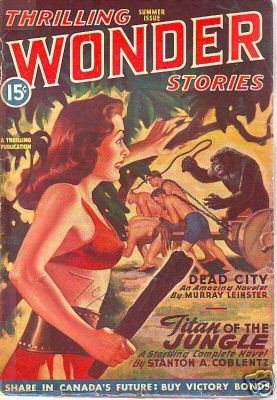
I had a night to myself last week and dove head first into my first pulp – Thrilling Wonder Stories, Summer 1946. Why did I pick this one from my tall stack of pulps? The Gorilla Cover. I can’t argue with Julie Schwartz’ logic – Gorilla Covers are real eye catchers. Pay close attention folks, as we will see some other Schwartz/DC connection later on.

Thrilling Wonder Stories started out life as Hugo Gernsback’s Wonder Stories, but was sold to Thrilling Publications and the title was changed. I don’t know much about the overall hierarchy of pulp magazines, but I’d imagine that Thrilling Wonder Stories is held in pretty high regard, at least for the sci-fi genre. Even if your just do a quick search for the title, you see some truly iconic covers.

The lead story of this issue is “Titan of the Jungle” and look what we’ve got here. An intelligent gorilla setting up a city in the middle of the jungle from which he plans to attack mankind. Does any of that sound familiar? It seems that Julius Schwartz might have borrowed more than just covers from this title. OK, OK – that’s a bit of a conspiracy theory – but some of the elements are there, even the name (anyone remember Titano from Superman).

It’s always fun to draw these kinds of parallels, but the real question here is ‘How do these Apes keep getting so smart?). In this case, it’s matter of a scientist creating two serums – one that enhances intelligence and another than lessens it. When Titan has his intelligence heightened he overpowers the scientist and starts dumbing down the local population. Luckily, friends of the scientist are honeymooning in Ghana (Gold Coast back then), as they must have pissed off their travel agent. After several unsuccessful attempts, they finally manage to take on Titan and his army of intelligent Apes. Of course, most of the credit is given to the sidekick Dog, apparently the only animal in Africa that didn’t have a vendetta against mankind.

I haven’t had the chance to read the rest of this magazine, but if the other stories are half as good as this one – it’s money well spent.

Thursday, August 03, 2006

I'm Dropping This Atom Bomb

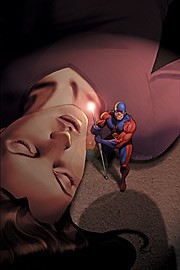
I really wish that I liked this title. I love the Atom. I mean love, love, love, love the Atom. The first issue did not exactly inspire much confidence, but I thought I’d be fair and give it another shot. I regret to say that I will not be picking up the 3rd issue. Here we have a book written by a talented writer and of the ‘Modern Masters’ at the drawing board, but someone this just does not work.

Now, I am willing to live with a non-Ray Palmer Atom, and Ryan seems like a pretty good character – but there are simply too many supporting characters. How many times will we have to endure these professors sitting around in all of the eccentric glory?. I also found the humour to be juvenile (fart jokes, pantless professors), and the flirty, giddy female characters to be annoying. The quotes, what can I say about the quotes? It’s not just that they are in the way and interrupt the flow of storytelling. They also seem to scream ‘Hey Reader! Comic Book Creators are Wicked Smart!’ Quotes can be an effective tool, when used sparingly and wisely – unfortunately that’s not the case here.

All of that being said, the real dealbreaker for me is the artwork. Every time I see John Byrne’s pencils these days, I want to drive to Terry Austin’s house and give him a big hug. The art is just horrendous. Byrne seems to have totally misplaced his sense of design and layout. Even the perspective he uses in some panels seems totally inappropriate. I am not even going to get into the actual quality of the pencil work, as I am afraid JB will track me down and lecture me for hours about how stupid I am.

Madam, I’m no longer buying this Atom.

Wednesday, August 02, 2006

My Favourite Places in the World Pt. 3

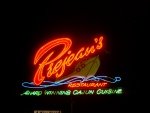
Prejean’s Restaurant: Lafayette, Louisiana

Lafayette is the unofficial capital of Cajun Country, USA. At first glance, however, there is not much that distinguishes it from any other smaller American city. Once you dig a little deeper, you discover that things are just a little different in this neck of the woods. It’s a good place for doing a little bayou exploration and to absorb the local history and culture.

Due to its ‘outside-of-town-off-the-highway’ setting, Prejean’s does not look like a legendary restaurant, worthy of mention in most travel guides. Instead, it just looks like an ordinary roadside diner, and you may question why you drove all the way out here. Once you step inside and hear the music, and get a good look at the huge stuffed alligator gars adorning the wall, you’ll suddenly realize that this ain’t Chili’s.

Prejean’s is a huge place: tons of table, tons of people eating as if it were their last meal on Earth. From a décor/ambience point of view, it’s nothing special – but it’s way off the charts on the kitsch scale. You grab a table, have a look at the menu and check your pocket for your Lipidor. I can’t remember precisely what I ate there – but it was a mixed platter with just about every Cajun delicacy on it. Every night at Prejean’s the Louisiana crawdaddy population takes a severe beating.

Due to the buzz of activity around you, you may feel inclined to speed through your meal. That would be a mistake. Take you time, sip your beer and enjoy the music. You won’t get to experience this kind of place very often in life so slow down. As Kat and I ate our meal, every now and then we’d just push back from the table and listen to the band and let the music soak in. They have awesome live music here – and I was thrilled to have a conversation in French with some of the band members during one of their breaks.

Yup, Prejean’s is a Louisiana institution and will certain attract its share of tourists (try as I might, I can’t pretend I’m not one) who will spend as much in the gift shop as they do on their meal – but that shouldn’t scare you off. It’s a great place, and well worth a visit should you every find yourself in Cajun Country.

Wednesday, July 26, 2006

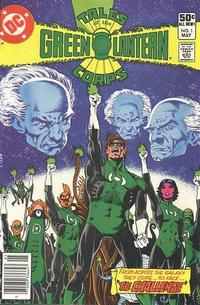
Memoirs of a Bronze Age Baby – Tales of the Green Lantern Corps #1

In the spring of 1982, I was 8 years old, turning 9 that October. For me, it was a real golden age as a young comic book fan. There were so many great titles at that time, and my allowance money was enough to keep me in funnybook heaven week after week. I had enjoyed Green Lantern in the GL/GA series (this was the Itty era) and later as it reverted to a solo title. I also enjoyed he JLA and B&B appearances. I wouldn’t say that he was ever my favourite character, but I liked him and the Guardians of the Universe angle allowed for almost limitless possibilities.

At that time, of course, I had no idea who Brian Bolland was – but when I saw this cover on the racks, I just had to have it. It is freaking gorgeous. It still stands out in my mind as one of the most iconic covers of the era. Of course, it was also a #1 and I was always very excited about getting in on the ground floor.

This was really my first introduction to the Corps. I was aware that it existed but I never really understood the size of the undertaking. The first few pages, featuring the gathering of every GL in the universe, were mind blowing. We also get a very quick recap of Hal Jordan’s origin as a GL, after he tells another GL of Abin Sur’s demise. To me, this was a form of mythology – the universe seemed boundless and the dedication of the Corps was impressive to say the least.

I did a quick re-read recently, and this Mike Barr tale holds up quite well. There is actually quite a bit of carnage for a pre-Crisis story, which I found to be surprising. The plot gets a bit fuzzy in places and the sentimentality (which resonated with me at the time) seems a bit forced at times, but that may have to do with cynicism than anything else.

The real treat here is the artwork by the Joe Staton/Frank McLaughlin team. Staton is near the top of the ranks of all-time underappreciated artists. He infuses so much energy in his pencils that they almost leap off the page. He should have become a superstar – but I guess nice guys rarely finish first. I am also a bit fan of McLaughlin as an inker – he work well with all sorts of artists – I am never surprised to see his name in the credits of a book that I’ve enjoyed.

What a great book this was! What a treasure it was to come across as an 8-year old. They simply do not make ‘em like this anymore.

Thursday, July 20, 2006

Essential Moon Knight

When I was a kid, I bought a few copies of Moon Knight off the racks (probably enticed by the covers – especially that painted Earl Norem cover), but never truly became a fan of the characters. Things just seemed too complicated – the multiple personalities, the guy with the tea bag etc… I used to hear people talk about how Moon Knight was just a Batman rip-off, but I never really got that. Sure they are some similarities (work at night, rich) – but that also applies to about 99% of heroes. Don’t forget, Batman piloted his own chopper.

The Essentials series gives me the chance to take a second look at a character I’ve glossed over at a very reasonable price. This volume starts off rather slowly with the initial Werewolf By Night issues – nothing special there. The early solo MK stories (in the Hulk Magazine) are pretty hit and miss, as Doug Moench doesn’t quite seem to have a good feel for where he plans on taking his creation just yet. The team-ups with Spidey and The Thing are pretty standard late 70s Marvel fare – pretty good fun, but nothing groundbreaking.

As far as I am concerned, things improved significantly with the launch of the regular series – the Sienkiewicz art really began to take off, very moody but still great with the action. Moench’s writing improved as he began to steer away from using hard boiled pseudo-Spillaine dialogue for MK that he used in the earlier issue. MK’s supporting cast is also fleshed out a bit more – although in including Gena’s kids seemed like overkill. There’s some really good stuff here. It ain’t Watchmen, but it’s pretty solid compared to some of the books Marvel was putting out in 1980. It also works very nicely in the black and white format. Gene Colan fans take note that the master did a very nice job on one fo the Hulk back-up stories. I love the fact that these books have hidden gems like that. I look forward to the second volume.

Monday, July 10, 2006

Quick Comic Reviews

Eternals #1
Marvels has tried and tried to make a success of the Eternals, one of the most ambitious concepts to come from the brain of the King. Upon seeing this book on the rack – I was not so sure how the team of Neil Gaiman and John Romita Jr would mesh. I’ve got to report that I was very happily surprised. A very strong start – I’m in for the whole miniseries. Grade: A

All-Star Superman #4
Nope – this one just didn’t do much for me. I love Jimmy Olsen and can certain appreciate someone trying to revisit some of his Silver Age charm, but this one just fell flat on its face. I think that all of the ironic ‘references’ to the 60s Olsen got in the way of the storytelling. Of course, there are worse books out there but this was a real disappointment after such a long wait. Grade: B-

Marvel Westerns #2: Kid Colt & Arizona Annie
Fun, fun, fun! What’s not to about a mixing the Old West with Skrulls? The Philadelphia Philly story also demonstrated a good mixture of humour and action – it was like watching an old episode of Maverick. This was such a fine issue – I really wish Marvel would consider making some sort of regular series with a rotating cast of characters, like Astro City. Not too thrilled with the reprints here – as they are all in the Rawhide Kid Masterworks. Grade: A-

Moon Knight #3
This series is starting to pick up some speed. I wasn’t so sure where they were heading with the whole ‘depressed Marc Spector’ angle – but we are now officially getting somewhere. I want to be patient with books, but this story was unraveling so slowly that I wasn’t sure if I would be able to maintain focus here. I am now officially in the groove, and you can count me in for at least another 5 issue. I thought the whole ‘How come you never told me?’ conversation with Frenchie was a bit ham-fisted. Grade: B+

Detective Comics #821
The last time I bought a copy of Detective Comics (some time in the last year or two), I was truly saddened to see how far this iconic title had fallen. I caught wind of the fact that Paul Dini was hopping aboard for some single-issue stories so I thought I’d check it out. This was good stuff – actual detective work once again. I liked the J H Williams art – but I am not a fan of that ‘punch effect’ he uses. Grade: A-

Atom #1
I haven’t a clue what happened to Ray Palmer – and don’t really care at this point – but I am a sucker for any hero who shrinks. This wasn’t a bad debut – but the overall tone is a bit unfocused and the initial shrinking scene was nothing new. There is some potential here, though – so I may stick around for a couple of issues. I am hoping they keep some of the ‘science’ motif that made the 60s series so great. Byrne is the wrong choice here. 25 years ago with Terry Austin inks, perhaps – but not today, we need a cleaner, more dynamic line here. Grade: B-

Thursday, June 22, 2006

The Return of the Mighty Marvel Western

How happy to you think I was to see this book on the shelf at my LCS? I was all like – Whaaaaa? A Mighty? Marvel? Western? I was so stoked to see that Marvel was giving western the same treatment that they gave Monsters last year.

It’s a pretty kooky idea – mixing old with new, action with humour. It worked with many of the Monster books, so I hoped that it work well here too. Dan Slott’s Two-Gun Kid story is a perfect example of why there should be more ongoing western titles today. It’s about as entertaining as anything you’ll read this year. You’ve got missing cattle, werewolves and Lone Ranger and Tonto look-alikes. It makes for a great story. The key here is Slott’s obvious love for the genre. Cowboys and comics are a great fit, and Slott seems to know it. The Barreto art was a perfect - he has a very good feel for portraying the Old West.

The second story is a pretty funny gag story by Keith Giffen. Nothing special, but these shorter tales are in keeping with the Silver Age Western tradition (minus the doll sex, of course). Finally, we’ve got an infamous Kirby drawn Rawhide Kid story. As we are living in the Age of Irony, this seems like a very appropriate reprint, as it shows just how hilarious things were back at the dawn of the Marvel Age. I’d actually prefer to see a more straightforward story against either a villain or a band of outlaws so that modern fans can see that Silver Age stories could be very entertaining without resorting to living totems.

But then, who am I to complain? I certainly never thought I’d see the words Mighty Marvel Western again.

Monday, May 29, 2006

The Passing of Alex Toth - Part 1

Alex Toth has died.

I guess like all things, it was inevitable. Still, there seemed to be so much life left in the man, his thoughts so sharp, his opinions so strong, that it looked like immortality might actually be in the cards.

In some ways it’s odd that such a giant in the comic book field, is best known by the general public much more for his contribution to the animation world. Today’s ‘Adult Swim’ crowd might not even realize that the likes of Space Ghost and Harvey Birdman were created by one of the best damned artists to work in the funnybook business.

Toth has always been seen as the ‘Cartoonist’s Cartoonist’. He is well respected within the creator community and has a very strong fan base. All of this for a man who bounced around from project to project, and company to company – never really having a definitive character, title or even genre for that matter.

I really don’t know all that much about the technical aspects of putting a comic book story together. My eyes tend to glaze over a bit when people get into a deep conversation about inking with a brush or spotting blacks. Deep down I really just prefer to rely on my immediate emotional response to the artwork. Perhaps more than any other artist, Alex Toth felt that there was a right way and a wrong way to tell a comic book story. He looked to the likes of Noel Sickles and Milt Caniff for inspiration. Early in his career, Toth was mentored by Sheldon Mayer, who encouraged him to master all aspects of comic book storytelling. Toth always felt that the job of the artist was to tell the story, and that anything else (such as what he called the ‘Kubert money-shot’) simply muddied the waters.

People will often look at a piece of Toth art, and talk about how it is brilliant because of the fact that he decided to leave out unnecessary details. I prefer to say that he took the time to contemplate precisely what needed to go into the page, and used only those elements. His use of silhouettes, his sound effects, the cut-off close-ups: all of these things gave a certain quite dynamism to the page and enabled him to catch the reader’s eye without relying on the double page splash. Simply put, Toth had his own way of telling a story and, more often than not, it was the right way.

The Passing of Alex Toth - Part 2

Let’s take a trip down memory lane.

Alex Toth got his start in the mid-40s, including some work for Famous Funnies Publications. A good way to see some early (and cheap) Toth art is to track down a copy of Heroic Comics. This is a very strange (by today’s standards) series depicting real life acts of heroism, usually in a two or three page story with a rotating cast of artists including Toth, Sid Greene and Fred Guardineer. It’s a pretty silly title, and Toth’s artwork may not be instantly recognizable, but they are a fun example of Golden Age goodness and can usually be found on eBay for under $5.

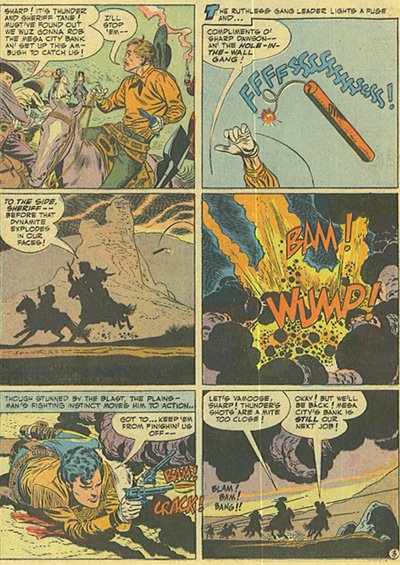
A year or so later, Toth began doing work for DC/National – including stints on the Green Lantern strip and All-Star Comics. Funnily enough, while Toth’s artwork was quite strong, it didn’t really seem full energized until the introduction of Streak the Wonderdog in Green Lantern. This was perhaps the first indication that Toth strengths might be away from the cape and tights crowd. Anyone who knows me knows that I am a big western fan, and for my money the high watermark of the genre was Toth’s run on Johnny Thunder in All-American Western. I have been picking these up whenever I see them for over a decade, and I am one issue (#121) shy of putting together a complete run. I’ll never understand why DC hasn’t given this strip the ‘Archives’ treatment, but anyone looking for inexpensive samples should track down a copy of Showcase #72 or the Johnny Thunder reprint title from the early 70s. Toth worked on other DC western titles, such as Jimmy Wakely and Dale Evans, but it is apparent that he preferred working on Bob Kanigher’s Johnny Thunder stories than any others at that time. The page I’ve included is a good example of Toth’s stylish approach to western storytelling.

Toth’s work really diversified in the 50s, as he worked for several companies in a wide range of genres. Standard/Nedor/Better Comics is nearly forgotten today, but this company brought us the likes of Black Terror and Xela airbrush covers in the 40s. By the 50s, under the Standard imprint, they published a variety on non-superhero titles including ultra violent war titles such as Joe Yank, schlocky horror titles such as The Unseen and plenty of old fashioned romance books. These books can be tough to find, but a little effort may be rewarded by strong artwork by Toth, Mike Sekowsky and Ross Andru. Romance comics are all but ignored by many of today’s comic book fans, but they once represent a vital part of the industry. A good story is a good story, and Toth brought a real freshness to the romance genre. The example I’ve included here is the first page to a short 3-page story from Today’s Romance #6 from 1952. I’d love to see an inexpensive collection of Toth’s romance work, but that’s not likely to happen.

Later in the decade, Toth began doing quite a bit of work for Dell. This included many movie adaptations for the Four Color title. Although I stated earlier that Toth is not truly associated with one character or series, he comes closest with Zorro. These adaptations of the Disney TV show allowed Toth to explore Old California and instill a good mixture of action and humour. Perhaps more than any other Toth work, these stories are a feast for the eyes as the reader is treated to an incredible sense of movement. These stories were reprinted in black and white (with Toth contributing to the new tones) first by Eclipse (I belive) and then later by Image. For anyone interested in getting a glimpse of what makes Toth so great, I strong recommend these reprints, as the black and white is a vast improvement on the colour versions.

The Passing of Alex Toth - Part 3

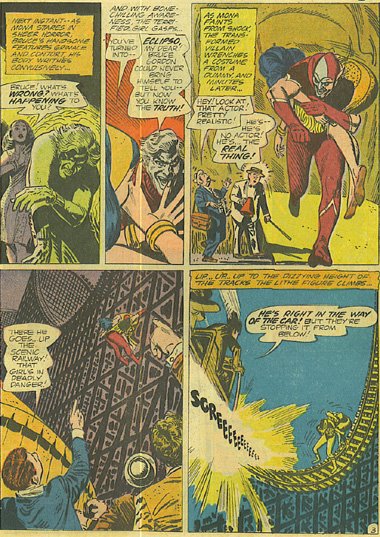
By the 60s, Toth was doing less comic book work and much more animation work, but was still making significant contributions, especially to DC. Eclipso is another in a long line of truly odd heroes introduced by DC in the 60s, perhaps trying to keep up with the House of Ideas. The strange concept of the villain as hero was made even stranger by Toth’s artwork on the strip – which veered away from superhero norms of the time. I’ve included a page here from House of Secrets #65 to give a sense of just how unique Toth’s approach to superhero comics was at the time. Another good example is the oft-reprinted Brave and Bold #53, featuring one of the better non-Batman team-ups. Toth also contributed several stories to DC’s line of mystery titles in the early part of the decade. Later in the 60s, he did some strong work for some DC romance titles as well as Hot Wheels.

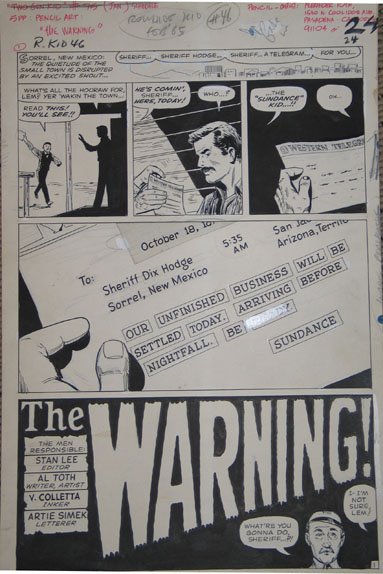
Stan Lee was well known for asking many DC artists to work for him (many under pseudonyms) in the 60s as the Marvel line was expanding. Artists such as John Romita and Gene Colan were given almost a fresh start at Marvel, and yet somehow Alex Toth made only minimal contributions. The best known example is X-Men #12, which has been reprinted several times, but the reader won’t get a true sense of what Toth could do, as he was working from Kirby layouts, who had a very different approach from Toth. A better example is the story ‘The Warning’, a very strong back-up story from Rawhide Kid #46. I own the title page from this story, and it is incredibly different from anything published from Marvel at that time. I can only assume that Stan Lee felt that Toth was simply a poor fit for his books, and didn’t offer any more work. Outside of DC and Marvel, other strong colour work from Toth can be found in some in Dell/Gold Key titles such as Frogmen and Twilight Zone. These can be found for a fraction of the price of a DC or Marvel book from the same era.

The Passing of Alex Toth - Part 4

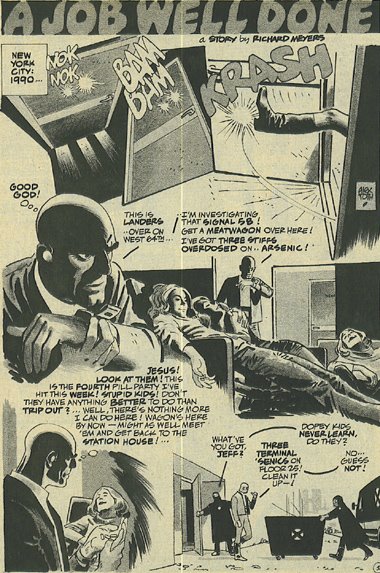
Jim Warren’s black and white magazine line gave many creators a sense of artistic freedom that they were denied by mainstream publishers. Some of Toth’s strongest work ever can be found in the Warren magazine. Blazing Combat is still one of, if not the, greatest war comics ever, and Toth’s contribution were integral to the series. These have become unbelievably pricey in recent years, and I’d love to see the stories reprinted in an affordable format. Toth’s work for the horror books was just as strong, and much of his work through the 70s would be in the horror genre. The page I’ve included here is from a mid-70s story and it demonstrates the dynamic layouts imagined by Toth, as the action all but leaps off the page. I've been trying to track down a copy of Creepy #139 for a few years now, as it is an all-Toth issue but I've had no luck.

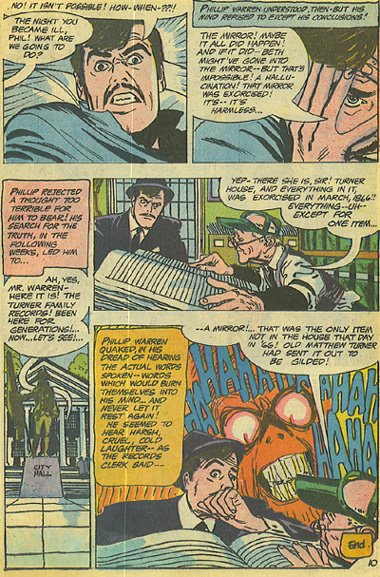
Warren was not the only place to find good horror stories, as DC’s revamped horror titles, edited by Joe Orlando tried to tap into the market revitalized by Jim Warren. Like many anthologies, the stories can be hit and miss, but Alex Toth made several contributions and they are all quite strong. Jack Oleck should be a much bigger name in the comic book work as he wrote some of the best horror stories ever, and he and Toth made for a formidable team. “The Devil’s Doorway” is only of the best DC horror stories ever published, and it’s rather shocking ending stands in stark contrast to the pap produced by DC just a decade earlier. The recently published Showcase Presents House of Mystery features a handful of Toth drawn stories including “The Devil’s Doorway” and is well worth checking out, as this price is right, they look good in black and white and these books can be tough to find.

It could be argued that Toth’s strongest work is from the 70s. Some of these stories, such as “White Devil…Yellow Devil” from Star Spangled Stories #164 and “Death Flies the Haunteds Sky” from Detective Comics #442, are very well known and have been reprinted several times. For my money, DC’s best story from the entire decade (that’s saying a lot!) is a back-up from Adventure Comics #431. The story entitled ‘Is a Snerl Human’ harkens back to an earlier time in comic book history when readers were often treated to 8-page morality plays. The story, written by Toth mentor Sheldon Mayer is comic book perfection, and it’s a crime that DC has not seen fit to reprint it in one form or another. As I’ve mentioned in an earlier blog entry, one of the hidden gems of the 70s is Atlas-Seaboard’s Thrilling Adventure Stories #2. The black and white magazine can be tough to track down, but the reader is rewarded with art by Walk Simonson, John Severin, Russ Heath and a very interesting story drawn by Toth.

In recent years, Alex Toth’s contributions to the comic book work have been limited to the odd pin-up or cover, but his ongoing contributions via memoirs to magazines such as Comic Book Artists and Alter Ego have provided a much needed window to the industry’s past. His passing means an end to these columns, and the silencing of a very important voice.

Rest in Peace, Alex – you’ve earned it.

Friday, May 26, 2006

Whither the Try-Out Book? - Part One

Last month, at the Paradise Toronto Comicon, I snagged a big stack of books from bargain bins. Among these were 10 or so copies of Marvel Premiere from the late 70s and early 80s. I have had some books from this title previously (the Liberty Legion, Ant-Man and Doctor Who issues), and I was happy to pick up some more. To me, this is a great way to introduce a new or revamped character. In particular, I always liked the Scott Lang Ant-Man books, along with his appearance in Marvel Team-Up.

Both Brave and the Bold and Showcase served DC well as a launching pad for new ideas in the 60s. Sure, it was a bit hit and miss and for every Justice League of America, there was a B’wana Beast, but it’s impossible to deny how much goodness came out of these two titles.

In the 60s, Marvel was able to (and forced to, due to distribution limits) introduce many of its successful new characters in already established titles, but these were not true try out books. By the 70s, however, Marvel decided the time had come to launch titles whose primary goal was to test how well readers would respond to new or revamped characters. By the mid-70s, Marvel had two titles dedicated to the premise. Ostensibly, Marvel Spotlight was supposed to give existing characters (Nick Fury, Deathlok) another kick at the can, whereas Marvel Premiere was to introduce brand new characters and concepts. Of course, there were exceptions to this rule, but I’ve read that was the plan.

Personally, I think try-outs books were a great way to test the waters, but I can’t see how they’d work in today’s Direct Market. In the 70s, a kid was likely to spot an issue and buy it off the shelves, but today’s marketplace does not really allow impulse buying. That’s too bad – but c’est la vie. Here’s a quick look at some of my recent reads

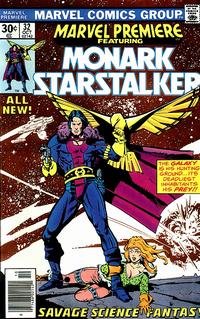
Marvel Premiere #32: Monark Starstalker

This is a decent little space western, with Chaykin transferring a Jonah Hex-like character to the deepest regions of space. It’s not bad stuff, better than most of the high concept stuff produced by both Marvel and DC. Chaykin’s artwork gets a it muddied in the printing process, but there was some real promise here – as Chaykin’s demonstrates that he is a unique creator (With hindsight, we know he covers much of this ground repeatedly, but judged on its own merits, it’s a good read.

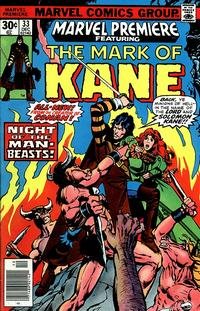
Marvel Premiere #33 & #34: Mark of Kane

Roy Thomas and Chaykin team up for a pretty pedestrian adaptation of a Robert E Howard story. The Solomon Kane stories in the b&w magazines were superior to this one, but that’s not saying much. Kane is a one note character, and absolutist philosophy makes one feel like they are reading a Steve Ditko comic. There’s not much characterization here, as the second half of the first issue is one prolonged swordfight. The second issue takes us on ridiculous manhunt to Africa - with some typical 70s voodoo and gorilla justice thrown into the mix. I guess Howard fans must have been happy to see their Puritanical hero in colour, but I wasn’t feeling it. I guess not every pulp hero truly deserves his own title in the 70s.

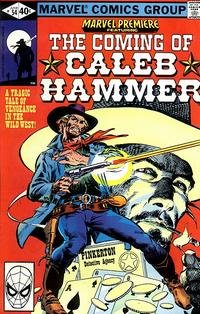
Marvel Premiere #54: Caleb Hammer

This time, Marvel doesn’t even bother putting Jonah Hex in space. This smells, looks and feels like a Jonah Hex comic book (right down to the Clint Eastwood-like appearance and Tony DeZuniga inks), but that’s not necessarily a bad thing. After years of publishing only reprinted western tales, Marvel reenters the western genre (as it is on its death bed) with this Peter Gillis about a Pinkerton with a tragic past. This art by the Gene Day/DeZuniga team is perfect for the story and in a different era, Caleb Hammer might have had a future. Sadly, this was 1980 and six shooters were out of vogue. There is one major flaw with this book – as occurs with most Marvel books. We learn Hammer’s full back story in this single issue. Part of the charm of Jonah Hex was his mysterious background, and analyzing the various hints that were dropped regarding his Confederate jacket and his scar.

That’s it for now – I’ll be back with a look at some more Marvel Premiere books in the near future.

Friday, May 12, 2006

An Offer You Can Refuse

The Godfather - Part III

I was given the trilogy on DVD a couple of years ago, and although my wife and I watched parts I & II right away, we were a bit Corleoned out and waited to watch this one. It caused quite a bit of controversy back in the day, as it people's expectations were so high that it was almost bound to fail. Sofia Coppola took most of the heat, and

As a standalone film - it's not bad. It's not great - but it would have been seen as a decent, elegantly shot mob family film. In comparison to Parts I and II, it comes across as disjointed, meandering and poorly written.

Sofia Coppola seemed to take the brunt of critisims on her shoulders - and although she is certainly not Olivier, the movie has enough flaws that they can be shared amongst the principals. Her Dad is mostly to blame as he is the architect for this slowly paced, highly repetitive story. The first two films were tightly woven, with a feeling a menace in almost every scene. So many scened in Part III make the viewer feel as though they are eavedropping on a boring family conversation.

While Ms. Coppola may not be much of an actress, she can hardly be faulted as she was just starting out. What excused does Eli Wallach have for his almost laughable job as Don Altobello. Honestly, my wife and I were giggling during the scene in which he chases after Joe Mantegna after he's left the boardroom. Trying to compete with him ham for ham are the rest of the principals, most notably Talia Shire - whose role was augmented here with fewer and fewer of the Corleone siblings still alive. It's a big shift from Brando, Caan, Duvall and Cazale to Wallach, Shire and Mantegna.

All of that being said, there as some decent moments - even if some of them (the opera 'excecutions across Europe' scene) echo scenes from the earlier films - but nothing really brings it all together. The found the entire Vatican business deals angle is really convoluted, and I used to work as an M&A lawyer!

I really wanted to like this film, as I don't mind being contrarian. I certainly didn't hate it, but I am really glad I didn't watch it immediately after the first two films, as I really think the flaws would have jumped out even more.

Friday, May 05, 2006

My Favourite Places in the World Pt. 2

Copacabana in Montreal

Montreal is full of bars. It’s full of great bars. Anyone who has ever visited the city is likely familiar with the Crescent St. liquor factories, has ordered cheap pitchers at a Peel Pub or has checked out the beautiful people lining up for a trendy place on St. Laurent.

When you spend 4 of your prime drinking years in Montreal like I did, you got through a type of evolution of bars. At the beginning, it is impossible not to be lured in by the siren song of the ‘All you Can Drink’ establishments that seem to have a 400:1 patron to bartender ratio. The next step (after stopping by at least 2 Peel Pubs to collect your free Birthday pitcher) is to check one of the countless bars on St. Laurent. There is something for everyone here – from pick up joints to mosh pits. When it comes down to serious drinking and laughs – you need a place with plenty of seating, cheap drinks and dim lighting to keep the amateurs at bay.

For me, as well as my nearest and dearest friends back then, that place was the Copacabana (which could not have more of an anti-Rio vibe if it tried). If you’ve seen the Oscar-winning short “Ryan”, you may recognize this place. It’s next door to the more popular Café Frappe and underneath the more (in)famous Double Deuce (where they seemed play the original version of ‘Jane Says’ every night). The Copa was the place to go when you’d had enough of the pseudo-hipster scene. As a added bonus, it was only a short 3 block walk back to my apartment on St. Urbain.

A few years ago, I was in Montreal for a conference along with one of my old McGill roommates. We decided to duck out of an afternoon session to walk around and soak up a little Montreal. Not less than a half hour later, we found ourselves sharing a pitcher at the Copa, as happy as pigs in shit. There are some things in life that just feel ‘right’.

Monday, May 01, 2006

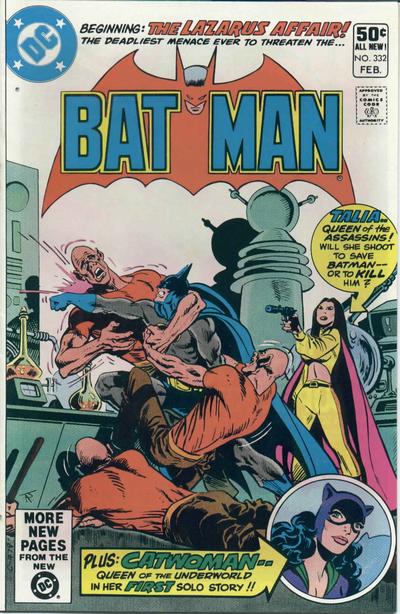
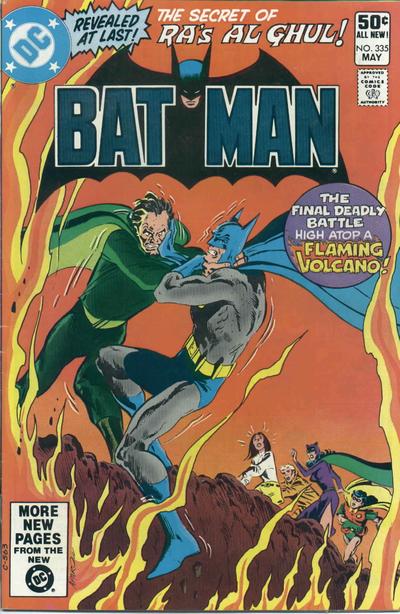
Memoirs of a Bronze Age Baby: The Lazarus Affair

How do I even begin with this one? This story arc than ran in Batman #332 to #335 is rarely brought up in ‘Batman’s Greatest’ type discussions, but I can’t think of anything I’ve re-read as often as The Lazarus Affair. What makes this one so special? How about a little Ra’ Al Ghul? How about Catwoman in her purple Golden Age costume? How about the return of King Farraday? How about the sexual tension that’s about as thick as a 100 Page Super Spectacular?

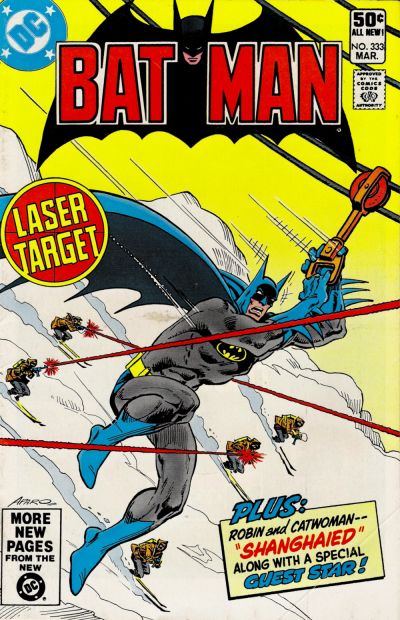
Of course, all of these elements are mixed together into a wonderful mélange by Marv Wolfman and drawn by the awesome team of Irv Novick and Frank McLaughlin. Novick certainly deserves to be counted among the top Batman artists, and I would use his great pencils here as proof. Of course, the Jim Aparo covers are even better! As an added bonus, we are treated to an ongoing solo Catwoman feature drawn by Don ‘Effin Newton! This is Bat-Heaven, folks!

I would have been 8 years old, going on 9 when these issues hit the stands and I was absolutely blown away by the intricate, cliffhanger filled storyline. Issues #333 starts of with a great Bond-like opening, complete with a ski chase (how did Batman click into those binding?). Sure this may not be Frank Miller, but it’s pretty darned engaging all the same. This was my first exposure to Ra’s Al Ghul, and I was really struck by his pure evilness. That scene with the guy escaping on the raft really made an impression on me. I also don’t think that I really understood all of the various relationships in Batman’s life until I saw Talia and Selina getting snippy with each other. I was also intrigued by the obviously strained relationship between Dick and Bruce. King Farraday was also a very mysterious, yet appealing figure and I was vaguely aware of the fact that he was a DC character from way back when.

This is all great stuff, with a lot of international intrigue thrown in for good measure. This was one of the first times I can remember experience physical pain while waiting for the next issue to be released. I don’t believe that this story arc has even been collected in a TPB, and that is a real mystery to me. There must certainly be a demand for it, as these issues have been getting pricier and pricier with each passing year. Pick it up if you can, it’s a great read. I still love revisiting the Lazarus Pit every couple of years.